Open Chain vs Closed Chain Exercises
If you have ever heard your therapist talk about open chain vs closed chain exercises during a rehabilitation or exercise program and wondered, “What does that actually mean?” you are not alone. These terms describe how your muscles and joints work together during movement and help explain why certain exercises are chosen for strength, stability, and recovery.
Your therapist may also refer to concepts like the anterior chain, posterior chain, or kinetic chain. While these terms can sound complicated, they are simply ways of understanding how different parts of your body work together to create efficient movement.
Understanding the purpose behind your exercises can help you stay engaged in your rehabilitation and understand how each movement supports your goals.
Here’s a simple breakdown:
🔹 Open Chain Exercises
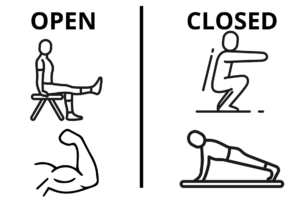
These are movements where your hand or foot is free to move. They’re great for isolating specific muscles, improving strength, and targeting weak areas. Any activity where your hand and foot are not fixed in weight bearing but freely moving with weight or not.
How They Work
- Free Limbs – Your hands or feet are not pressing against the floor or a fixed object.\
- Single Focus – They often focus on just one joint and one main muscle group at a time.
- Muscle Targeting – Great for building size or strength in a specific spot.
Common Examples
- Bicep Curls: Your upper arm stays still while your hand moves freely holding a weight.
- Leg Extensions: Done in a chair and not on a leg press (this is a closed chain) while you elevate your lower leg while your foot moves through the air.
- Lat Pulldowns: Your body stays seated while your hands pull a bar down.
Benefits
- Targeted Strength – Helps build up one weak muscle safely.
- Easy Recovery – Used often in physical therapy to heal hurt joints without heavy body weight. Early rehab strategy.
🔹 Closed Chain Exercises
These involve your hand or foot staying fixed against a surface, like the floor or a wall. Think squats, push-ups, or step-ups. These exercises train multiple muscles to work together and often better reflect everyday movements. Basically closed chain exercise are weight bearing exercises used to improve stability and the functional use of multiple muscles and joints at one time. We don’t usually act in on plane with one muscle at a time so closed chain exercises help rehab and improve ability to do functional tasks.
How They Work
- Fixed Limbs – Your hands or feet stay planted on a solid surface.
- Multiple Focus – They involve multiple joints and many muscle groups moving at the same time.
- Compression: They apply weight directly through your bones and joints, which stimulates stabilization.
-
- Squats – Your feet stay glued to the floor while your entire body moves up and down.
- Push-ups – Your hands remain flat on the ground while you push your torso away from the ground.
- Pull-ups – Your hands grip a fixed bar while your body pulls itself upward.
Benefits
- Functional Strength – They mimic everyday movements like sitting down, standing up, or pushing or pulling something.
- Joint Stability – They trigger surrounding muscles to fire together, making your joints more stable and robust.
Squat Muscle breakdown
Main Muscles Used
- Quadriceps – Front thigh muscles that straighten your knees as you push back up.
- Gluteus Maximus – Buttock muscles that power your hips upward from the bottom of the squat.
- Adductors – Inner thigh muscles that help stabilize your hips.
- Hamstrings – Back of the thigh muscles. They assist with hip extension and knee stability.
- Calves (Gastrocnemius and Soleus) – Lower legs muscles. They help control ankle movement and balance.
- Core (Abdominals and Obliques) – Front and sides of the abdomen muscles. Maintain your torso upright.
- Erector Spinae – Lower back muscles. Support and stability for your spine.
🔹 Anterior Chain or Front of Body Chain
This refers to the muscles along the front of your body, including your chest, abs, hip flexors, and quadriceps. These muscles help with movements like pushing, lifting, and maintaining posture.
🔹 Posterior Chain Back of Body Chain
This includes the muscles along the back of your body, such as your glutes, hamstrings, calves, and back muscles. A strong posterior chain is essential for walking, climbing stairs, lifting safely, protecting your back as well as good posture.
💡 Why does this matter?
When we assess or treat musculoskeletal (MSK) conditions, we’re not just looking at the painful area, we’re looking at how your whole body moves together. Sometimes the source of pain isn’t where you feel it. Choosing the right exercises for the “right chain” can improve movement, reduce pain, and help prevent injuries from coming back.
Understanding these terms means understanding why you’re doing certain exercises and how they help you get back to doing what you love.
Have you ever been given an exercise and wondered, “Why this one?” Ask the question??? Understanding your rehab is one of the best ways to get the most out of it.